Back to All Training Tracks
SAE J3016 & ISO 26262/21448Perception & ADAS 6 Weeks

ADAS Sensor Physics, Perception & Multi-Sensor Fusion

Deep physical and algorithmic understanding of 77GHz Radar, Camera ISP pipelines, LiDAR Time-of-Flight (ToF), Ultrasonic sensing, and Extended Kalman Filter (EKF) sensor fusion.

Production Vehicle Architectural Blueprint

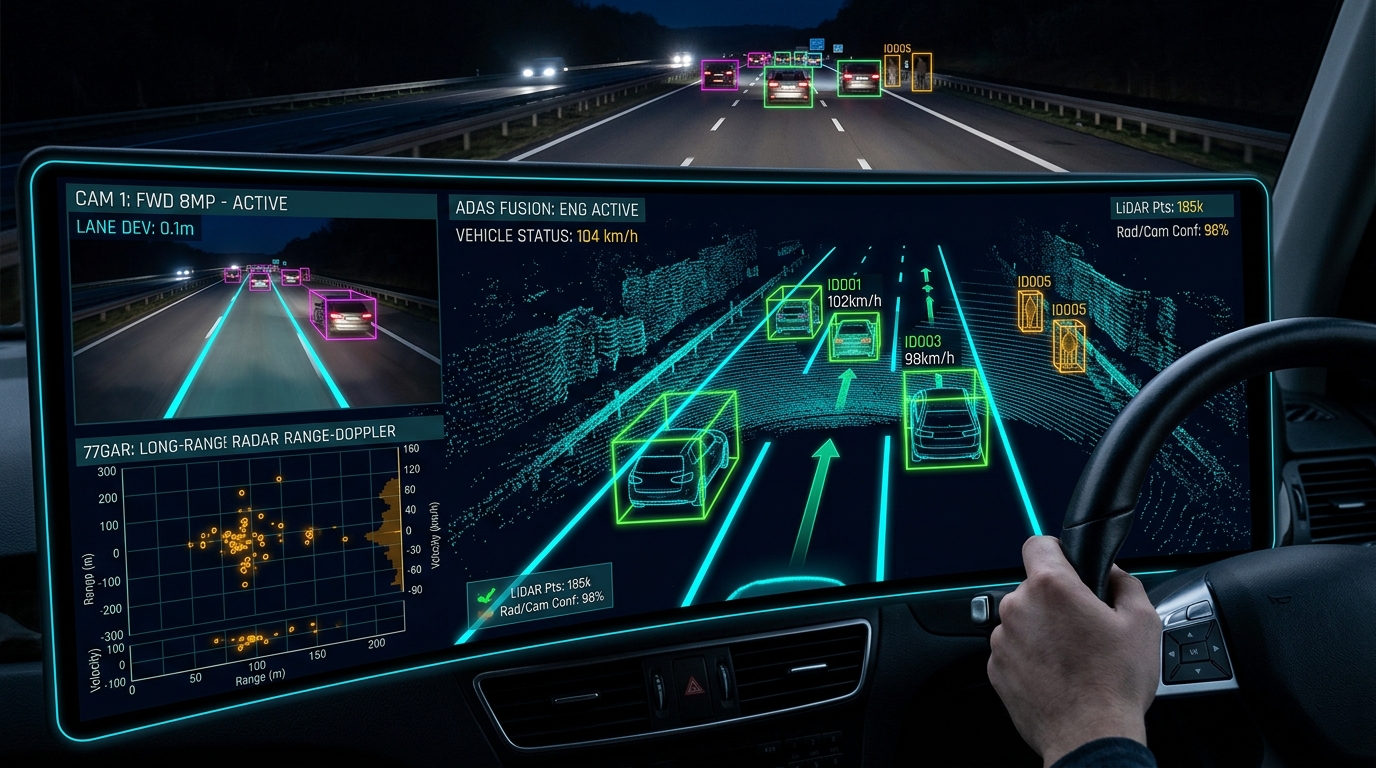
ADAS Multi-Sensor Perception Fusion Cockpit HUD: Camera, 77GHz Radar & LiDAR

Real-time 3D bounding box detection, range-Doppler cluster maps, and dense point cloud tracking at 104 km/h.

Sensor FusionEKF Tracking77GHz Range-Doppler3D LiDAR Point Cloud
ADAS Multi-Sensor Perception Fusion Cockpit HUD: Camera, 77GHz Radar & LiDAR
OFFICIAL AUTOSYS TECHNICAL CAD BLUEPRINT
Hands-On Engineering Practice

Interactive Domain Laboratory & Case Studies

Complete each stage interactively with visual architectural schematics, case studies, and voice dictation.

ADAS Perception & Sensor Physics Laboratory

Multi-Sensor Physics & Kalman Filter Fusion

From CMOS Camera ISP and 77GHz FMCW Radar Range-Doppler FFTs to 1550nm LiDAR Point Clouds and Extended Kalman Filter (EKF) multi-target tracking.

Perception Suite:
Perception Physics Fundamentals

Comparing Optical Wavefronts vs. 77GHz Millimeter Waves

Wavelength λ: 4mm (Radar) vs 500nm (Optical)
Optical Camera Strengths & Physical Degradation

Optical cameras deliver rich semantic classification: lane markers, traffic signs, and brake lights. However, optical photons have nanometer wavelengths (λ ≈ 400-700 nm). Fog droplets (≈ 10 μm) and rain droplets are much larger than optical wavelengths, causing severe Rayleigh and Mie scattering.

77GHz FMCW Radar Millimeter-Wave Physics

77GHz radar emits chirps with a wavelength of approximately 3.9 millimeters (λ = c / f). Because millimeter waves are orders of magnitude larger than microscopic fog and rain droplets, radar signals penetrate adverse weather with almost zero attenuation.

ADAS Multi-Sensor Perception Fusion Cockpit HUD
ADAS COCKPIT HUD: 8MP VISION, 77GHz RADAR & 3D LIDAR FUSION104 KM/H HIGHWAY CRUISE
Perception World Model: Forward camera 3D bounding box, 77GHz range-Doppler cluster, and LiDAR point clouds.Extended Kalman Filter (EKF) Fusion
Trainee Lab Exercise: Sensor Physics & Weather ResilienceSpeak or Type your response

Question: In an automotive interview, explain why an autonomous vehicle cannot rely solely on cameras in heavy fog, and why 77GHz radar provides instantaneous relative velocity without differentiation over time.

Stage 1 of 6
Interactive ADAS Sensor Fusion Simulator

Multi-Sensor Degradation & Extended Kalman Filter (EKF) Fusion

Simulate adverse environmental conditions and observe how multi-sensor fusion overcomes individual sensor failure modes.

Individual Sensor Perception ConfidenceDense Fog (50m Visibility)
Forward Camera (HDR Optical ISP)35%

Blinded by glare, fog, heavy spray, or darkness

77GHz FMCW Radar (Doppler Velocity)92%

Penetrates precipitation and fog; measures direct velocity

1550nm Solid-State LiDAR (3D Point Cloud)50%

Centimeter-level depth; scattered by dense fog water droplets

Multi-Sensor Fusion (EKF Composite)Safe Object Tracking Active
Fused Track Confidence Score
66%

Tracking target safely across vehicle trajectory

Active Condition Impact: Optical scattering severely blinds camera and attenuates 905nm LiDAR pulses. 77GHz millimeter-wave Radar penetrates unobstructed.

Why Fusion Wins: Even when the optical camera drops to 35% confidence, the 77GHz radar provides target range-rate while the LiDAR maintains 3D spatial bounding, preventing ghost braking or missed detections.

Conforms to SAE J3016 Level 3 & ISO 21448 SOTIF sensor redundancy principles
Interactive Visual Masterclass🎙️ NotebookLM Multi-Speaker Engine● Daily Stacked Episode #1

ADAS Sensor Physics: Camera ISP, 77GHz Radar & 3D LiDAR Fusion (EKF)

Featuring Dr. Aris Thorne (Senior Safety Fellow) & Elena Vance (Principal Safety Assessor) · Added 2026-10-01 · 27 mins

ADAS Sensor Physics: Camera ISP, 77GHz Radar & 3D LiDAR Fusion (EKF)
VEHICLE CAD ARCHITECTURE
AT
Dr. Aris Thorne
Senior Safety Fellow
·
EV
Elena Vance
Principal Assessor
Dr. Aris Thorne(Senior Safety Fellow)

Elena, let's talk about why autonomous driving cannot rely on cameras alone. What is the fundamental physical limitation of optical imaging in automotive environments?

Elena Vance(Principal Safety Assessor)

Physics does not negotiate, Aris. A camera is a passive 2D sensor measuring reflected photons. When heavy fog, driving rain, or direct low-angle sunlight strikes the camera lens, contrast collapses. A camera cannot directly measure distance or velocity—it must infer depth using neural networks or stereo disparity. That inference degrades rapidly in adverse weather.

Dr. Aris Thorne(Senior Safety Fellow)

Which is why we pair it with 77 gigahertz millimeter-wave radar and LiDAR.

Elena Vance(Principal Safety Assessor)

Exactly! 77 GHz radar waves have a wavelength of approximately 3.9 millimeters—they penetrate water droplets and fog with minimal attenuation. And radar gives you instantaneous Doppler velocity in a single chirp, without waiting across multiple video frames. When you fuse radar velocity with camera classification and LiDAR 3D geometry using an Extended Kalman Filter, you create an unshakeable perception model.

Line 1 of 425% Complete
ADAS Sensor Physics: Camera ISP, 77GHz Radar & 3D LiDAR Fusion (EKF)

Deep physical and algorithmic walkthrough of automotive perception sensors: rolling shutter CMOS cameras, 77GHz radar range-Doppler FFTs, solid-state LiDAR point clouds, and Extended Kalman Filter (EKF) tracking.

Stacked Masterclass Series (3)Daily Cadence
Hardware & Software Interfaces
8MP Forward Vision
Calculates optical flow, lane boundaries, and vehicle 3D bounding boxes.
77GHz Long-Range Radar
Direct Doppler measurement providing instant relative speed without waiting for multi-frame differentiation.
3D LiDAR Point Cloud
185,000 laser returns per second building millimeter spatial surface models.
EKF State Estimation
Combines sensor covariance matrices to output stable target position, velocity, and heading.
Independent Engineering Takeaways
  • Physical failure modes: Atmospheric attenuation, rolling shutter artifacts, and radar multipath
  • Range-Doppler matrix processing: Extracting radial velocity and micro-Doppler pedestrian signatures
  • Extended Kalman Filtering (EKF) and Hungarian track-to-detection data association
Detailed Knowledge Repository

Engineering Curriculum & Standards Guidance

1. Camera Physics: Rolling Shutter, HDR & ISP Pipelines

Optical fundamentals, dynamic range challenges, and edge distortion

Automotive CMOS image sensors must handle extreme dynamic ranges (> 120 dB) transitioning rapidly from dark tunnels into bright sunlight.

Rolling vs. Global Shutter: Rolling shutter causes spatial distortion for high-speed cross-traffic targets; automotive cameras use specialized mitigation or global shutter sensors.

Image Signal Processing (ISP): Demosaicing, tone mapping, bad pixel correction, and chromatic aberration compensation.

Core Architectural Takeaways

  • Lens soiling, glare, and low illumination are the primary SOTIF triggering conditions for optical cameras.

OEM & Tier-1 Technical Interview Guidance

Interview Question: Why do automotive cameras use RCCC or RCCB color filter arrays instead of standard RGB Bayer filters?

Winning Answer: Clear (C) pixels capture significantly more light than green or blue filters, dramatically improving low-light SNR and sensitivity for nighttime pedestrian detection.

2. 77GHz FMCW Radar & Doppler FFT

Chirp modulation, range-Doppler maps, and radar ghost reflections

Automotive radar emits Frequency Modulated Continuous Wave (FMCW) chirps at 76-81 GHz.

A 2D Fast Fourier Transform (FFT) computes target Range (Range FFT) and Relative Velocity (Doppler FFT) directly in hardware.

Radar penetrates fog, dust, and rain where optical systems fail, but suffers from multipath reflections (ghost targets) from metallic bridges and guardrails.

Core Architectural Takeaways

  • Radar provides direct, high-precision velocity measurement via the Doppler effect.
  • Multipath ghost rejection is a critical radar tracker algorithm.

OEM & Tier-1 Technical Interview Guidance

Interview Question: How do you distinguish a real stopped car from a radar ghost reflection?

Winning Answer: By tracking historical trajectory coherence, checking elevation angle resolving capabilities, and cross-validating target existence against camera and LiDAR point clouds.

3. LiDAR Technology & Multi-Sensor Fusion (EKF)

Time-of-Flight (ToF), 905nm vs 1550nm lasers, and Extended Kalman Filtering

LiDAR measures direct 3D point clouds with centimeter-level depth accuracy using pulsed laser Time-of-Flight.

905nm lasers are cost-effective but limited in power for eye safety. 1550nm lasers operate in the eye-safe spectrum, permitting higher power and 250m+ highway detection ranges.

Sensor Fusion: Combines complementary strengths: Camera (rich classification) + Radar (exact velocity & weather robustness) + LiDAR (exact 3D spatial geometry) through an Extended Kalman Filter (EKF).

Core Architectural Takeaways

  • Sensor fusion guarantees that single-sensor degradation (e.g. fog or glare) does not cause system blindness.
  • Hungarian algorithm associates detections with existing tracked objects.

OEM & Tier-1 Technical Interview Guidance

Interview Question: What is the difference between Early (Raw-level) and Late (Object-level) sensor fusion?

Winning Answer: Early fusion combines raw sensor data (pixels and point clouds) before feature extraction, offering higher information density but requiring immense compute bandwidth. Late fusion combines object bounding boxes and velocities from each sensor's independent tracker, providing fault isolation and modularity.

AutoSys Professional Certification

Earn Your Accredited Automotive Credential

Register for a free learner account to save your lab progress, unlock downloadable templates (HARA Excel sheets, FMEDA calculators, GSN safety case templates), and earn your verified completion certificate.