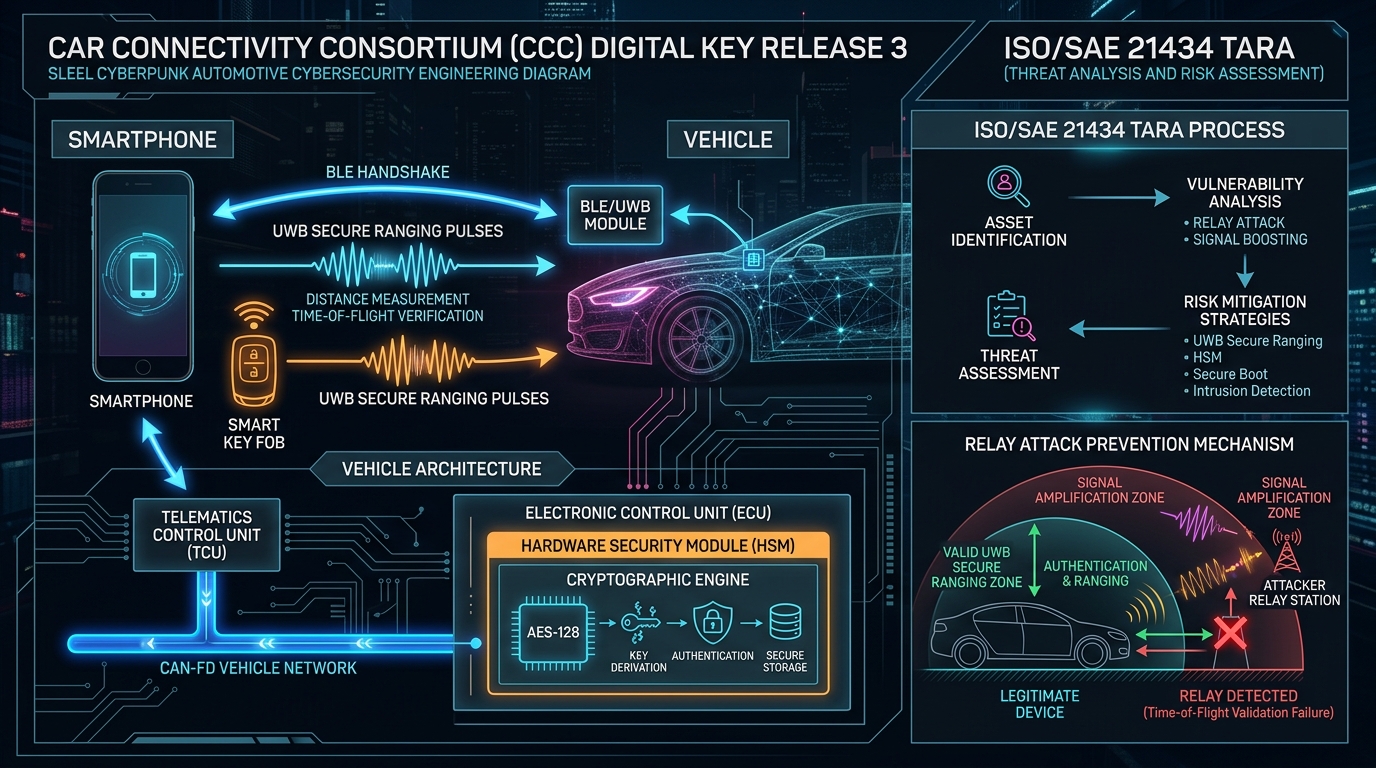
1. Threat Analysis & Risk Assessment (TARA - Clause 15)
Asset identification, damage scenarios, threat scenarios, and attack feasibility
TARA is the cybersecurity counterpart to HARA. It identifies vehicle assets whose compromise impacts Safety (S), Financial (F), Operational (O), or Privacy (P) properties.
Threat Scenarios are modeled using STRIDE (Spoofing, Tampering, Repudiation, Information Disclosure, Denial of Service, Elevation of Privilege).
Attack Feasibility is calculated using either CVSS v3.1 or Attack Potential based on elapsed time, specialist expertise, equipment cost, and window of opportunity.
Core Architectural Takeaways
- Cybersecurity goals translate directly into cybersecurity requirements on software and hardware.
- Unlike functional safety, cybersecurity risk is dynamic and changes after SOP as new zero-day exploits emerge.
OEM & Tier-1 Technical Interview Guidance
Interview Question: How do you evaluate Attack Feasibility for an automotive telematics ECU?
Winning Answer: By calculating the composite score across Elapsed Time, Specialist Expertise, Knowledge of the Target, Window of Opportunity, and Equipment. Remote cellular attacks generally carry high feasibility if unauthenticated.