Back to All Training Tracks
ISO 21448:2022Automated Driving Safety 4 Weeks

ISO 21448 SOTIF (Safety of the Intended Functionality)

Master safety for systems where hazards arise without component hardware or software faults: camera blinding, radar multipath reflections, AI perception edge cases, and unexpected weather conditions.

Production Vehicle Architectural Blueprint

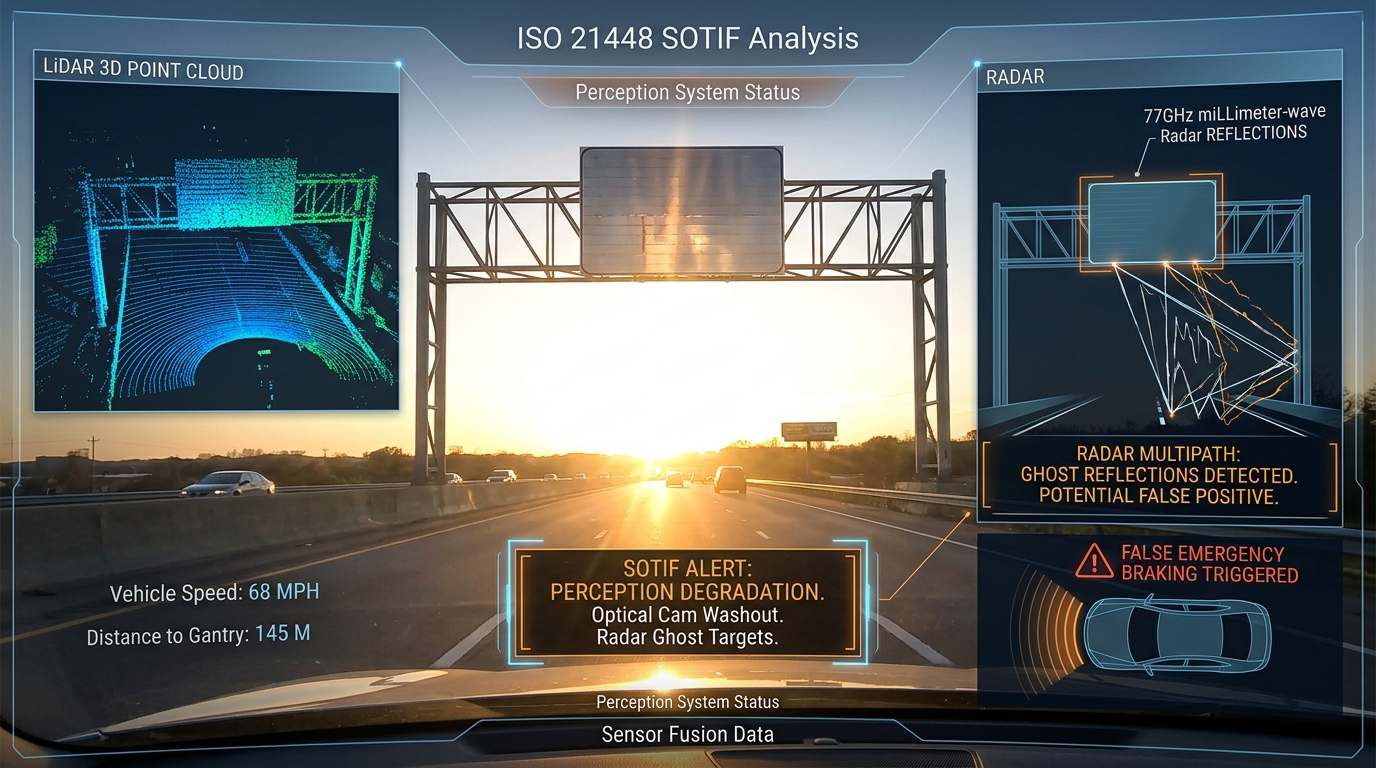
ISO 21448 SOTIF: Camera Glare & 77GHz Radar Multipath Analysis

Optical CMOS saturation washout and overhead metallic sign multipath ghost reflection interception display.

ISO 21448 SOTIFArea 3 Migration77GHz MultipathCamera Washout
ISO 21448 SOTIF: Camera Glare & 77GHz Radar Multipath Analysis
OFFICIAL AUTOSYS TECHNICAL CAD BLUEPRINT
Hands-On Engineering Practice

Interactive Domain Laboratory & Case Studies

Complete each stage interactively with visual architectural schematics, case studies, and voice dictation.

ISO 21448 SOTIF Engineering Laboratory

Safety of the Intended Functionality Lifecycle

Discover and systematically eliminate hazards that occur without any hardware or software component failure. Master Triggering Conditions, ODD formulation, and Scenario-based testing.

Case Study:
ISO 21448 Clause 5

Stage 1: Operational Design Domain (ODD) Formulation

Work Product: SOTIF-01 System Specification & ODD

In SOTIF, the Operational Design Domain (ODD) specifies the exact operating conditions under which the automated driving feature is designed to function safely: environmental parameters (precipitation rate, ambient lux), roadway characteristics (divided highway vs. urban intersections), speed ranges, and geographical boundaries.

ISO 21448 SOTIF Sunset Glare and 77GHz Radar Multipath
SOTIF SCENARIO: SUNSET GLARE & 77GHz RADAR MULTIPATHISO 21448 CLAUSE 5
Visual SOTIF Scenario: Camera CMOS pixel saturation vs 77GHz overhead gantry multipath reflection.Area 3 Unknown Unsafe Mitigation

System ODD Boundary Specification: Autonomous Emergency Braking (AEB)

Precipitation & Weather

Dry or light rain (≤ 10 mm/h). Heavy downpours, thick snow, and blinding dense fog trigger graceful driver handoff.

Illumination Limits

Ambient lux: 50 lux to 100,000 lux. Direct optical glare when exiting dark tunnels requires multi-sensor complement.

Operational Speed Window

Active from 10 km/h up to 130 km/h on divided highways

Trainee Lab Exercise: ODD Boundary FormulationSpeak or Type your response

Question: For the AEB Highway system, explain what happens when the vehicle travels outside the specified ODD (e.g. into blinding torrential rain > 25 mm/h), and why SOTIF forbids abrupt deactivations without warning.

SOTIF Stage 1 of 6
Interactive ISO 21448 SOTIF Simulator

The 4 SOTIF Quadrants & Risk Migration Matrix

Observe how massive scenario simulation shrinks Area 3 (Unknown Unsafe) into verified safe operating space.

SOTIF Operational Space (ISO 21448 Figure 3)
Area 1: Known Safe

Nominal verified driving conditions

69.3%
Area 2: Known Unsafe

Known sensor limits (e.g. blinding snow)

12.0%
Area 4: Unknown Safe

Safe conditions not yet cataloged

10.4%
Area 3: Unknown Unsafe ⚠️

Unforeseen edge cases & SOTIF hazards

8.3%
Scenario-Based Verification PipelineISO 21448 Clause 10
Virtual Simulation Fleet Miles:10,000 miles
Adversarial Triggering Conditions Tested:45 / 100 cases
SOTIF Rule of Convergence: As simulated edge cases and corner-case scenarios grow, the residual risk volume of Area 3 converges towards zero, enabling defensible commercial release.
Interactive Visual Masterclass🎙️ NotebookLM Multi-Speaker Engine● Daily Stacked Episode #1

ISO 21448 SOTIF: Triggering Conditions & Sensor Dynamic Range Failures

Featuring Dr. Aris Thorne (Senior Safety Fellow) & Elena Vance (Principal Safety Assessor) · Added 2026-10-01 · 25 mins

ISO 21448 SOTIF: Triggering Conditions & Sensor Dynamic Range Failures
VEHICLE CAD ARCHITECTURE
AT
Dr. Aris Thorne
Senior Safety Fellow
·
EV
Elena Vance
Principal Assessor
Dr. Aris Thorne(Senior Safety Fellow)

Elena, let's explain SOTIF to an engineer who already knows ISO 26262. In ISO 26262, if every transistor works and every line of code is bug-free, the system is safe. In SOTIF, that same system can kill people.

Elena Vance(Principal Safety Assessor)

Exactly. SOTIF is 'Safety of the Intended Functionality'. There is zero software bug. Zero hardware short circuit. But the camera image sensor gets blinded by direct sunset glare at 70 mph, or the radar pulses bounce off an overhead highway sign and mimic a stationary truck. The autonomous emergency braking slams on the brakes with zero obstacle ahead—a ghost braking event.

Dr. Aris Thorne(Senior Safety Fellow)

How does an engineer systematically uncover these scenarios?

Elena Vance(Principal Safety Assessor)

Through the SOTIF Triggering Condition Matrix. You categorize triggering conditions into Environmental (sun glare, road spray, tunnel exit), Target Characteristics (black vehicle absorbing LiDAR, pedestrians with reflective jackets), and System Limitations (rolling shutter distortion, neural network out-of-distribution hallucinations).

Line 1 of 425% Complete
ISO 21448 SOTIF: Triggering Conditions & Sensor Dynamic Range Failures

Understand why defect-free ADAS systems cause fatal crashes due to optical CMOS sensor saturation, heavy rain backscatter, and radar multipath reflections.

Stacked Masterclass Series (3)Daily Cadence
Hardware & Software Interfaces
Direct Sunset Glare
Dynamic range exceeds 120dB sensor limit, causing pixel blowout and lane marker loss.
Overhead Gantry Multipath
Bounces between pavement and overhead steel sign mimic a stationary vehicle in lane.
LiDAR Spatial Ground Truth
3D point cloud verifies the physical road profile, overriding camera and radar illusions.
Fusion Confidence Filter
Rejects single-sensor false triggers unless corroborated by spatial point density.
Independent Engineering Takeaways
  • The fundamental difference between ISO 26262 (faults) and ISO 21448 (performance limits)
  • Optical CMOS saturation dynamics during tunnel exit and low-angle sunset glare
  • 77GHz radar multipath ghost clustering on metallic highway gantries
Detailed Knowledge Repository

Engineering Curriculum & Standards Guidance

1. The Core SOTIF Challenge: Failures Without Faults

Why ISO 26262 alone is insufficient for ADAS & Autonomous Vehicles

ISO 26262 addresses system hazards caused by malfunctioning behavior (e.g., bit-flip, broken wire, software bug).

ISO 21448 addresses hazards where every component works perfectly according to specification, yet the vehicle causes harm due to functional limitations (e.g. wet road glare blinding camera, unexpected pedestrian silhouette).

SOTIF focuses on identifying Triggering Conditions in the operational environment that cause functional deficiencies.

Core Architectural Takeaways

  • Malfunction vs. Limitation: ISO 26262 fixes bugs and component failures; SOTIF expands operational capability.
  • Triggering conditions include low sun angles, heavy spray, unusual vehicle geometries, and ambiguous road markings.

OEM & Tier-1 Technical Interview Guidance

Interview Question: Give a real-world example of a pure SOTIF hazard.

Winning Answer: An Automatic Emergency Braking (AEB) system falsely slamming the brakes on a highway because a metallic overhead bridge sign reflected radar chirps, mimicking a stopped vehicle.

2. The 4 SOTIF Areas & Scenario Migration Strategy

Shrinking Area 3 (Unknown & Unsafe) through massive scenario exploration

Area 1: Known Safe Scenarios (Nominal operation).

Area 2: Known Unsafe Scenarios (Known sensor limitations; mitigated through ODD restrictions or driver handoff).

Area 3: Unknown Unsafe Scenarios (The true hazard zone; corner cases yet to be discovered).

Area 4: Unknown Safe Scenarios.

The primary goal of SOTIF verification & validation is to systematically discover Area 3 scenarios and migrate them into Area 1 (by improving algorithms) or Area 2 (by setting safe operational limits).

Core Architectural Takeaways

  • Simulation and scenario databases (e.g., OpenSCENARIO) are mandatory to explore Area 3.
  • Acceptance criteria: Demonstrating that residual risk in Area 3 is acceptably low.

OEM & Tier-1 Technical Interview Guidance

Interview Question: How do you demonstrate that Area 3 is sufficiently small for commercial release?

Winning Answer: Through statistical validation combining billions of virtual simulation miles, shadow-mode fleet logging, and boundary-value stress testing demonstrating asymptotic convergence.

AutoSys Professional Certification

Earn Your Accredited Automotive Credential

Register for a free learner account to save your lab progress, unlock downloadable templates (HARA Excel sheets, FMEDA calculators, GSN safety case templates), and earn your verified completion certificate.