Back to All Training Tracks
ANSI/UL 4600 Standard for SafetyDriverless & Robotaxis 4 Weeks

UL 4600: Evaluation of Autonomous Product Safety

The definitive standard for fully driverless vehicles (SAE Level 4 & 5). Learn Goal Structuring Notation (GSN), building defensible safety cases, and eliminating human driver assumptions.

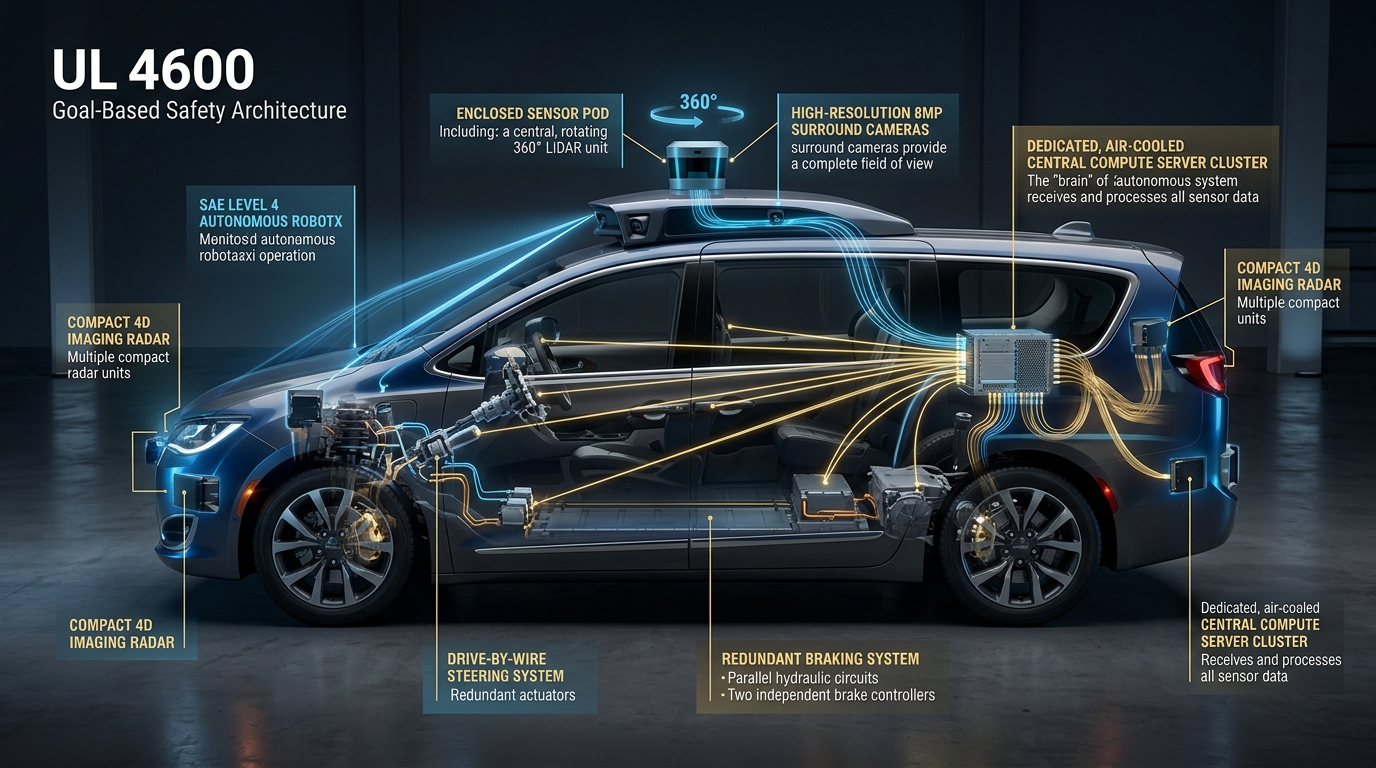
Production Vehicle Architectural Blueprint

SAE Level 4 Autonomous Robotaxi 360° Sensor Pod & Compute Architecture

ANSI/UL 4600 goal-based architecture: rotating roof LiDAR, surround 8MP cameras, corner 4D radar, and redundant actuators.

ANSI/UL 4600SAE Level 4360° LiDAR PodRedundant Braking/Steering
SAE Level 4 Autonomous Robotaxi 360° Sensor Pod & Compute Architecture
OFFICIAL AUTOSYS TECHNICAL CAD BLUEPRINT
Hands-On Engineering Practice

Interactive Domain Laboratory & Case Studies

Complete each stage interactively with visual architectural schematics, case studies, and voice dictation.

ANSI/UL 4600 Autonomous Safety Engineering Laboratory

Driverless Vehicle Safety Case & GSN Certification

Master the safety principles for driverless systems (SAE Level 4 & 5). Build Goal Structuring Notation (GSN) safety cases that defend perception, planning, and Minimum Risk Maneuvers without human fallback.

Platform:
UL 4600 Section 5

Stage 1: The Zero-Human-Fallback Principle

SAE Level 4 / 5 Mandate

In ISO 26262, Controllability ($C$) relies heavily on a driver reacting in 1-2 seconds. Under UL 4600, there is NO attentive human driver. The autonomous vehicle itself must be capable of handling all perception degradation, component failures, and edge cases, and autonomously transition to a Minimum Risk Maneuver (MRM).

ANSI UL 4600 Autonomous Robotaxi 360 LiDAR and Sensor Pod
SAE LEVEL 4 ROBOTAXI SENSOR SUITE & REDUNDANT COMPUTEANSI/UL 4600 SECTION 5
Zero-Fallback Sensor Pod: 360° roof LiDAR, surround 8MP vision, and redundant drive-by-wire actuators.Fail-Operational Minimum Risk Maneuver (MRM)
Trainee Lab Exercise: Defend the Zero-Fallback PrincipleSpeak or Type your response

Question: How does an autonomous Urban Robotaxi execute a Minimum Risk Maneuver when a primary compute module or steering actuator fails on a multi-lane highway?

Stage 1 of 6
Interactive UL 4600 Goal Structuring Notation (GSN)

Autonomous Safety Case & Evidence Visualizer

UL 4600 requires a rigorous, evidence-backed safety argument that does not assume human driver fallback.

Safety Argument Fully Defensible

All goals have substantiated empirical proof and valid ODD assumptions.

Goal: G1Top Safety Claim: Vehicle executes Dynamic Driving Task (DDT) safely in Urban ODD with zero human fallback.
Context: C1ODD: Daylight and night, precipitation <= 20 mm/h, mapped geofenced urban zone up to 35 mph.
Strategy: S1Argument by multi-modal perception diversity and independent collision avoidance.
Solution: Sn1Evidence 1: 50,000 km closed-course proving ground tests with zero safety operator interventions.
Artifact: Proving ground telemetry logs version 2.4
Solution: Sn2Evidence 2: Hardware lockstep fault injection demonstrating transition to Minimum Risk Maneuver (MRM).
Artifact: HIL test run #9481 results
Interactive Visual Masterclass🎙️ NotebookLM Multi-Speaker Engine● Daily Stacked Episode #1

ANSI/UL 4600: Constructing Goal Structuring Notation (GSN) Safety Cases

Featuring Dr. Aris Thorne (Senior Safety Fellow) & Elena Vance (Principal Safety Assessor) · Added 2026-10-01 · 27 mins

ANSI/UL 4600: Constructing Goal Structuring Notation (GSN) Safety Cases
VEHICLE CAD ARCHITECTURE
AT
Dr. Aris Thorne
Senior Safety Fellow
·
EV
Elena Vance
Principal Assessor
Dr. Aris Thorne(Senior Safety Fellow)

Elena, UL 4600 is revolutionary because it's the first standard that says: 'There is no human driver in the car to save you.' What does that mean for an engineer authoring a safety argument?

Elena Vance(Principal Safety Assessor)

It means you can no longer say 'Controllability is C2 because the driver can brake.' The vehicle IS the driver. In UL 4600, you must construct a Goal Structuring Notation (GSN) tree. Top Claim: The vehicle operates safely in the ODD. Strategy: Argue over nominal driving, hardware dependability, perception limits, and Minimum Risk Maneuvers. And every single claim must terminate in concrete evidence—not just opinions.

Dr. Aris Thorne(Senior Safety Fellow)

What is an auditor's biggest red flag when reviewing a GSN safety case?

Elena Vance(Principal Safety Assessor)

Circular arguments and unsubstantiated claims. If you claim 'Perception classifies all vulnerable road users with zero misses' without defining the context or acknowledging edge cases (like pedestrians in Halloween costumes or children on skateboards), your safety case will be shredded by third-party reviewers.

Line 1 of 425% Complete
ANSI/UL 4600: Constructing Goal Structuring Notation (GSN) Safety Cases

How to author an audit-ready Goal Structuring Notation (GSN) safety case for an SAE Level 4 driverless vehicle, linking top-level safety claims to concrete validation evidence without assuming human driver fallback.

Stacked Masterclass Series (3)Daily Cadence
Hardware & Software Interfaces
Top-Level Goal (G1)
Claim that vehicle operates safely without human intervention across defined urban ODD.
Argument Strategy (S1)
Argue safety across 3 pillars: Hazard Prevention, Anomaly Detection, and Fallback Maneuvers.
Context Nodes (C1)
Specifies urban ODD boundaries: daylight, speeds up to 35 mph, geo-fenced downtown district.
Evidence Solutions (Sn)
Concrete test reports: 10M simulated miles, HIL fault injection, proving ground track tests.
Independent Engineering Takeaways
  • Eliminating the human driver controllability assumption for SAE L4 Robotaxis
  • Structuring Goals, Strategies, Contexts, Assumptions, and Solutions in GSN
  • Linking shadow-mode fleet mileage and closed-loop SIL simulation evidence to safety claims
Detailed Knowledge Repository

Engineering Curriculum & Standards Guidance

1. Overcoming the Zero-Human-Fallback Assumption

Why traditional automotive safety principles must be rewritten for L4/L5

In ISO 26262, Controllability (C) assumes a human driver will intervene to steer or brake within 1-2 seconds.

UL 4600 assumes NO HUMAN DRIVER is present or attentive. The vehicle itself must execute the complete Dynamic Driving Task (DDT) and fallback to a Minimum Risk Maneuver (MRM).

UL 4600 is Goal-Based rather than prescriptive: you must state clear safety claims and prove them with comprehensive evidence.

Core Architectural Takeaways

  • No reliance on human driver reaction or attention.
  • Requires systematic defense of sensor suites, perception edge cases, and machine learning models.

OEM & Tier-1 Technical Interview Guidance

Interview Question: How does UL 4600 differ from ISO 26262 in approach?

Winning Answer: ISO 26262 is process- and metric-prescriptive. UL 4600 is argument- and evidence-based (Goal-based), requiring a structured safety case demonstrating why the autonomous system is safe in its ODD.

2. Goal Structuring Notation (GSN) & Safety Arguments

Connecting Goals, Context, Strategies, Assumptions, and Concrete Evidence

GSN provides a graphical notation for building audit-ready safety arguments.

Goal (G): What claim are you making? (e.g., 'Perception safely identifies all pedestrians within 50m').

Context (C): What is the environment? (e.g., 'Day and night in urban ODD up to 35 mph').

Strategy (S): How do you prove it? (e.g., 'Argument by multi-modal sensor diversity').

Solution (Sn): What is the empirical proof? (e.g., '10,000 real-world edge tests + 1,000,000 simulation runs').

Core Architectural Takeaways

  • A safety case is only as strong as its weakest unsubstantiated assumption.
  • Evidence must be reproducible, version-controlled, and tied to operational telemetry.

OEM & Tier-1 Technical Interview Guidance

Interview Question: What is an 'unsupported claim' in GSN?

Winning Answer: A goal or strategy node that lacks a linked concrete Solution (evidence artifact) or contains an invalid assumption.

AutoSys Professional Certification

Earn Your Accredited Automotive Credential

Register for a free learner account to save your lab progress, unlock downloadable templates (HARA Excel sheets, FMEDA calculators, GSN safety case templates), and earn your verified completion certificate.